




Problems with “Peel Chain Behaviors” in Crypto Tracing
In cryptocurrency prosecutions, government experts frequently point to “peel chains” as definitive evidence of a single user managing illicit funds over time. However, this forensic shortcut relies on structural assumptions that are highly vulnerable to litigation challenges.
The mechanics of this methodology—and its inherent logical leaps—were starkly illuminated in United States v. Sterlingov, 719 F. Supp. 3d 65 (D.D.C. 2024), a foundational criminal trial evaluating the Daubert admissibility of blockchain analytics software like Chainalysis Reactor. While the court ultimately admitted the evidence under Federal Rule of Evidence 702, its detailed breakdown of peel chain behavior provides defense counsel with a clear roadmap for cross-examination.
The Anatomy of a Peel Chain in Crypto Tracing
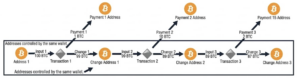
The peel chain heuristic exists because of a fundamental design rule within the Bitcoin protocol: Unspent Transaction Outputs (UTXOs) cannot be split. Bitcoin does not function like a bank account balance where a user can subtract a partial amount; it functions like physical cash. If an address holds a single 2.0 BTC output and the user wants to spend only 0.2 BTC, the protocol requires them to spend the entire 2.0 BTC. The wallet automatically generates a transaction with two distinct destinations:
- The Peel: The 0.2 BTC payment sent to the actual recipient.
- The Change: The remaining 1.8 BTC sent back to a newly generated “change address” controlled by the sender’s wallet.
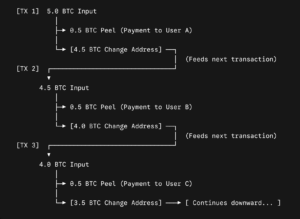
When a high-volume wallet executes multiple sequential transfers, this process repeats, creating a cascading visual chain on the ledger.
Visualizing the Peel Chain Concept
The diagram below illustrates how a large pool of cryptocurrency is sequentially stripped or “peeled” down across multiple transactional steps. As the graphic shows, a single large balance (2.0 BTC) is systematically reduced. At each step, a small payment is “peeled” away, while the remaining bulk balance cascades forward into a new address.
The fundamental flaw in peel chain analysis is an issue of directionality. On the public ledger, a standard transaction simply looks like one input splitting into two outputs. Absent proprietary software metadata, there is nothing inherent in the raw blockchain data that distinguishes which output is the external payment and which output is the internal change.
Forensic software companies attempt to solve this blind spot by looking for a “closing loop.” As the Sterlingov court noted:
“[W]hen Chainalysis ‘finds the end of the chain and finds a co-spend with an address that appeared at the beginning of the chain,’ it can then ‘demonstrate[] that the full peel chain is controlled by the same wallet.'”
Id. at 74.
In theory, if an address at Step 5 is mixed in a multi-input transaction (co-spent) with an address from Step 1, the software concludes that a single wallet must have held the private keys for both endpoints, thereby validating every inferred “change” link in the middle.
Tactical Angles for Defense Cross-Examination
Although the Sterlingov court was satisfied that this methodology met the “more likely than not” threshold for admissibility, the prosecution’s reliance on peel chains remains highly fertile ground for trial defense. Practitioners can dismantle the illusion of scientific certainty by focusing on three distinct vulnerabilities:
The Missing “Closing Loop”
The government’s expert will often map a peel chain that simply ends at a cold wallet or a nested exchange deposit without ever looping back to a known origin point. Without a co-spend closure, the determination of which address constitutes “change” is not a mathematical certainty—it is a probabilistic inference generated by a proprietary algorithm.
Multi-User Wallets and Shared Architecture
The peel chain heuristic assumes a strict 1-to-1 relationship between a digital wallet and a single biological human. This assumption collapses when applied to automated commercial platforms. High-volume darknet marketplaces, localized mixing services, and decentralized applications routinely utilize centralized wallet architectures that co-mingle completely unrelated user funds, mimicking a single-user peel chain script.
False Positives in Change-Address Detection
Wallet developers frequently update their software to randomize output order, alter fee metrics, and intentionally obfuscate change addresses to protect user privacy. If Chainalysis’s proprietary ruleset misidentifies an external payment as an internal change address at a single step in a 20-part chain, every subsequent link in that chain is completely severed, fatally corrupting the entire attribution.
This article was last updated on Monday, June 8, 2026.