

Case Results in Civil Asset Forfeiture Cases
We represent clients after their cash is seized for civil asset forfeiture proceedings in Florida and across the country. Many of these seizures occur at airports, bus stations, train stations, or on the roadway. More and more of our cases involve the seizure of cryptocurrencies from cryptocurrency exchanges.
When someone calls our office for a consultation, they often ask, “What kinds of forfeiture cases have you taken in the past, and what was the outcome in those cases?” We maintain this list of recent civil asset forfeiture case results to answer those questions.
If you would like to view the case results listed below, then you should read the following disclaimer:
- The Florida Bar does not approve or routinely review case results posted by attorneys.
- The facts and circumstances of your case may differ from the facts and circumstances discussed here.
- Not all case results are listed here or provided.
- The case results discussed here are not necessarily representative of the results obtained in all cases.
- Each case is different and must be evaluated and handled on its own merit.
Click here to read more about how we handle civil asset forfeiture cases involving a cash seizure.
CBP Returns Vehicle Seized for Non-CAFRA
On July 23, 2026, the U.S. Customs and Border Protection (CBP) seized a vehicle at the Port Tampa. On August 5, 2026, CBP issued a Notice of Seizure and Information to Claimants, Non-CAFRA Form. CBP alleged that the property was seized and subject to forfeiture according to 19 USC 1595a(d), 22 USC 401, 19 CFR 192.2 – Export of Self-Propelled Vehicles and/or Vehicle Parts Without Presenting Vehicle and Documentation Required by Regulations, and 19 USC 1595a(d), 22 USC 401, 15 CFR 30.71(b)(4), 15 CFR 30.6(a)(l 7) – Incorrect Shipment Value in Electronic Export Information (EEi). After the client hired Sammis Law Firm (SLF), on August 19, 2026, we filed the client’s verified claim for court action, election of proceedings form, and cost bond. On September 9, 2026, twenty-one (21) days after filing the claim for the client, CBP notified SLF that it had decided to release the vehicle to the client and refund the cost bond.
CBP Office in Tampa Returns All $20,148.00 U.S. Currency Seized at the Airport
On February 3, 2026, U.S. Customs and Border Protection (CBP) agents seized $20,148.00 U.S. Currency, along with some foreign currency, from our clients at the Tampa International Airport in Tampa, FL.
CBP alleged our clients attempted to evaded the reporting requirement and failed or inaccurately reported taking over $10,000.00 out of the U.S. pursuant to 31 USC 5317(c)(2), 31 USC 5324(c) and 31 USC 5317(c)(2), 31 U.S.C. 5316(a)(1)(A).
After our clients received a notice of seizure, we helped them filed a claim for court action with CBP within the 35-day deadline for filing a claim.
After reviewing the case, the Assistant United States Attorney declined to file a complaint for forfeiture in the United States District Court, which then triggered a requirement that CBP immediately return 100% of the seized funds to the client.
On April 23, 2026, Tracey Lynn Baer for Robert M. Del Toro, Fines, Penalties, and Forfeiture (FPF) Officer at the CBP Office located at 5519 W. Hillsborough Avenue, Tampa, FL 33634, issued a letter explaining that all funds would be returned.
DEA Agrees to Return $36,315.00 Seized During a Traffic Stop
On March 20, 2026, $36,315.00 was seized at a traffic stop by the Drug Enforcement Administration (DEA) agent(s) in Jackson County, Mississippi (also known as a “roadside interdiction”).
Local law enforcement officers alleged that our client was in violation of the illegal manufacture, distribution, or possession of a controlled substance pursuant to 21 U.S.C. 881 and the additional federal laws of 19 U.S.C. sections 1602-1619, 18 U.S.C. section 983 and 28 C.F.R. Parts 8 and 9. Those allegations were based on the fact that a large amount of cash was in the vehicle and other highly circumstantial evidence.
DEA adopted the seizure and sent out a notice of seizure to our client. Attorney Leslie Sammis at Sammis Law Firm prepared a verified claim for court action that was filed with DEA within the 35-day deadline. Within a month of receiving the claim for court action, we were contact by an Assistant United States Attorney who explained that based on the information we provided and DEA’s investigation, the AUSA told DEA it would “decline” filing a complaint for forfeiture.
Once the AUSA declined, DEA was forced to immediately return 100% of the property back to the client. We received a letter from DEA on May 7, 2026, explaining their decision to return 100% of the property.
CBP Returns $21,335.00 Seized at the Hartsfield-Jackson Atlanta International Airport
On January 23, 2026, agents with Customs and Border Protection (CBP) seized U.S. Currency from a husband and wife preparing to travel on an international flight with their two children at the Hartsfield-Jackson Atlanta International Airport, in Atlanta, GA.
As the family was preparing to board a Qatar Airways flight out of the country, U.S. Customs and Border Protection (CBP) agents alleged they had not filed out the FinCEN 105 form properly, as required by Title 31, United States Code, Section 5317(c)(2).
CBP also accused the family of “cash structuring” during flight screening. Structuring occurs when travelers intentionally divide currency or monetary instruments totaling over $10,000 among family members or travel companions to intentionally evade mandatory federal reporting requirements under Title 31 United States Code, Section 5316 and Section 5324.
CBP then issued a receipt on DHS Form 6051S(08/09). On the day of the seizure, CBP gave the family $1,000 back for “humanitarian release.”
After we were retained, we helped the husband and wife file a verified claim for court action that was “filed” at the appropriate CBP office. After providing documents showing the source of the funds and refuting any allegation of cash structuring, CBP agreed to return $21,335.00 and a hold harmless agreement was reached on June 4, 2026.
HSI Agent Releases Freeze on 1.694 Bitcoin (BTC) in a Binance Account
We were retained in April of 2026 after our client’s Binance account holding over 1.694 Bitcoin (BTC) in a Binance account was frozen at the request of an agent with U.S. Homeland Security Investigations (HSI).
Before we were retained, the client had spent more than a year emailing the HSI special agent who kept requesting additional information but refused to explain any lawful basis for why the cryptocurrency was frozen.
When we first contact the HSI agency shortly after being retained, he sent the following email:
Good morning, Ms. Sammis.
As this matter is part of an ongoing federal investigation, I am limited in what I can discuss and unfortunately cannot provide substantive details about the status of the case. I also cannot comment on or disclose any information that may have been obtained through the grand jury process.
I am forwarding your contact information and email to AUSA ______. He should be reaching out to you as soon as he’s available.
Respectfully,
[Redacted name of the agent]
Special Agent
Homeland Security Investigations (HSI)
SAC Houston / Cyber Investigations
HSI – USAO SDTX Cybercrimes Liaison
On May 18, 2026, we helped the client file a verified claim for court action. We also contact the AUSA. After providing additional information and preparing a Rule 41(g) motion for return of property, the agent and AUSA finally agreed to release the funds.
The HSI agent sent the following email:
Ms. Sammis,
Thank you for your inquiry regarding [name of client redated] and the [frozen bitcoin in Binance Account UID# __________].
I am writing to inform you that Homeland Security Investigations (HSI) has concluded its federal investigation into this matter and is not pursuing further enforcement action. We have notified Binance that our original request for a courtesy freeze was made pending review of certain records and that the federal investigation is now closed.
Any further action regarding the disposition of the assets is now a civil matter between Binance, Coinbase, and the account holders, and will be subject to Binance’s internal policies and procedures.
Please note that this determination by HSI does not preclude any state or local authorities from pursuing their own investigation or enforcement action if they choose to do so.
If you have additional questions regarding the status of the assets, we recommend you contact Binance directly.
Respectfully,
[redacted]
Special Agent
Homeland Security Investigations (HSI)
SAC Houston / Cyber Investigations
HSI – USAO SDTX Cybercrimes Liaison
Binance restored the account a few days later.
CBP Returns $25,000 Seized at the Dallas-Fort Worth International Airport
U.S. Customs Border Protection (CBP) seized $27,687.00 on February 22, 2025, from claimant and traveling companion at the Dallas-Fort Worth International Airport and returned $1,687.00 to claimant and traveling companion for humanitarian reasons. CBP alleged that claimant and the traveling companion violated 31 USC 5317(c)(2), 31 USC 5316(a)(1)(B) for Failure/Inaccurate Report of Over $10,000 Into the U.S., and 31 USC 5317(c)(2), 31 USC 5324(c) for Structuring Transactions to Evade Reporting Requirements. CBP initiated a forfeiture action on the $26,000.00, and only the claimant received a Notice of Seizure. Sammis Law Firm filed a claim for court action and Election of Proceedings one month after the seizure occurred on behalf of the claimant. Less than 3 months after the seizure, CBP returned all of the money seized.
CBP Returns $12,175.59 Seized at Border Crossing Station
On June 3, 2025, U.S. Customs Border Protection (CBP) seized $13,404.91 from claimant in Portal, North Dakota, at the border crossing station. CBP alleged that claimant violated 31 USC 5317(c)(2), 31 USC 5316(a)(1)(B) – Failure/Inaccurate Report of Over $10,000 Into the U.S. Claimant received a Notice of Seizure and Sammis Law Firm filed a claim for court action, along with the Election of Proceedings with CBP. After deliberations, CBP agreed to return $12,175.59 five months after the seizure occurred and the client agreed to forfeit the difference.
Broward County Sheriff’s Office Returns $25,000.00 Seized at the Fort Lauderdale-Hollywood International Airport
On July 8, 2025, the Broward County Sheriff’s Office (BCSO) seized $25,000.00 from claimant and a traveling companion at the Fort Lauderdale-Hollywood International Airport. Sammis Law Firm filed a demand for Adversarial Preliminary Hearing (APH) with BCSO 7 days after the seizure and requested that the video from the airport be preserved. After reviewing the case, the BCSO decided to return the seized funds.
Broward County Sheriff’s Office Returns $15,027.00 Seized at the Fort Lauderdale-Hollywood International Airport
$15,027.00 was seized by the Broward County Sheriff’s Office (BCSO) on March 20, 2025, alleging that the claimant violated Section 932.701 of the Florida Statutes. Five days after the seizure, Sammis Law Firm filed a demand for Adversarial Preliminary Hearing (APH) on behalf of the claimant with BCSO. One month later, the Senior Assistant General Counsel with the Office of the General Counsel at the Broward Sheriff’s Office agreed to return all of the money seized.
Tampa Police Department (TPD) Returns Seized Vehicle
On March 7, 2025, the Tampa Police Department (TPD) seized a vehicle belonging to the claimant. The claimant never received a Notice of Seizure but Sammis Law Firm filed a demand for Adversarial Preliminary Hearing (APH) on behalf of the claimant with TPD. Twelve days after the seizure, TPD released the vehicle to the claimant.
Pasco County Sheriff’s Office (PCSO) Returns Seized Vehicle
On March 3, 2025, the Pasco County Sheriff’s Office (PCSO) seized a vehicle from the claimant alleging the claimant was in violation of the Florida Contraband Forfeiture Act, Sections 932.701-704, Florida Statutes. Sammis Law Firm filed a demand for Adversarial Preliminary Hearing (APH) on behalf of the claimant with PCSO. A hearing was scheduled; however, PCSO agreed to return the vehicle to the claimant 24 days after the seizure but before the scheduled hearing which was cancelled.
CBP Returns $32,608.00 was seized at the Orlando International Airport
$32,608.00 was seized at the Orlando International Airport on August 16, 2025, by the U.S. Customs Border Protection (CBP). CBP released $1,716.00 to claimant for humanitarian reasons. CBP alleged that the claimant violated 31 USC 5317(c)(2), 31 USC 5316(a)(1)(B) for Failure/Inaccurate Report of Over $10,000 Into the U.S.
Claimant received a Notice of Seizure two (2) days after the seizure. On behalf of the claimant, Sammis Law Firm filed a verified claim for court action and present information about problems with how the seizure occurred. Two months after the seizure, CBP dropped the forfeiture action and agreed to return 100% of the seized funds.
CBP Returns $21,824.00 Seized at the Tampa International Airport
On June 17, 2025, U.S. Customs Border Protection (CBP) seized $21,824.00 from the claimant at the Tampa International Airport. CBP seized the money alleging that the claimant failed to report taking over $10,000.00 out of the United States under 31 USC 5317(c)(2) and 31 USC 5316(a)(1)(A). Sammis Law Firm filed a verified claim and Election of Proceedings on behalf of the claimant. After presenting information about problems with the way the seizure occurred, CBP returned all of the seized money within 4 months of the seizure.
USSS Returns $925,121.82 USDT Seized from a Binance Account
On November 12, 2025, the United States Secret Service (USSS) ( tlrinfo@usss.dhs.gov ) returned 925,121.82 USDT, worth $925,121.82, seized from a Binance Account to Sammis Law Firm. The seizure was part of a forfeiture action related to a criminal case pending in the Eastern District of Texas. We provided information to the USSS and the assigned AUSA that the funds were improperly seized from our clients and should be returned.
$2,170,000 USDT in a Binance.com Unfrozen
We were retained on August 8, 2025, to represent clients living overseas with a Binance account worth over $2,170,000 worth of USDT. The clients had retained us after 33 months of requesting information from Binance customer service only to be repeatedly told the “account under internal review” or “completion expected soon.”
After determining the account was frozen at the request of the FBI, we filed a verified claim demanding court action which was signed by our clients. We were then contacted by a DEA Special Agent and the Assistant United States Attorney (AUSA) assigned to the case and scheduled a phone conference.
Based on their concerns, we helped our clients provide additional records showing how the transactions occurred, and why they had no knowledge that some small portion of the funds could allegedly be traced to a vast money laundering enterprise.
The AUSA indicated they would normally seize the funds, start the forfeiture process, and provide my clients with direct notice of the seizure. But in this case, based on the information provided, they decided not to take that action because our clients had explained, in detail, that they were unwittingly involved.
The information provided was helpful to the federal investigation and suggested our clients made trades without properly vetting the source of the funds and/or the trade counter-party, but had no criminal intent. For those reasons, the FBI and AUSA decided to withdraw the FBI’s Tether USDT freeze request on September 11, 2025. The next day, the account was unfrozen.
CBP Returns $20,000 Seized at Orlando International Airport
$20,000.00 was seized by the U.S. Customs Border Protection (CBP) on June 5, 2025, at the Orlando International Airport. CBP alleged that the money was from unlawful activity pursuant to 18 USC 981(a)(I)(C), I8 USC 1956(c)(7), 18 USC 1961(1) – Proceeds of Unlawful Activity. Claimant received a Notice of Seizure and was given 35 days to file a claim. Sammis Law Firm filed a claim for court action and an Election of Proceeding on behalf of the claimant. Based on information we presented about the circumstances surrounding the seizure, the AUSA “declined” to file forfeiture proceedings which forced CBP to return 100% of the seized money.
CBP Returns $80,000.00 Seized at the Miami International Airport
On May 8, 2025, U.S. Customs Border Protection (CBP) seized $84,186.00 from claimant and 4 traveling companions at the Miami International Airport. CBP alleged that the money was subject to forfeiture under the provisions of 31 USC 5317(c)(2), 31 USC 5324(c) – Structuring Transactions to Evade Reporting Requirements, 31 USC 5332(c), 31 USC 5332(a) – Concealed Bulk Cash/Import, and 31 USC 5317(c)(2), 31 USC 5316(a)(l)(B) – Failure/Inaccurate Report of Over $10,000 Into the U.S. CBP provided a receipt for the money in the claimants name only; along with, only mailed the claimant a Notice of Seizure within 22 days of the seizure. Sammis Law Firm filed a claim for court action on behalf of the claimant and within 5 months of the seizure, an offer was accepted and CBP returned $80,000.00.
FBI Returns $61,000.00 Plus Interest Seized at the Portland International Airport
Claimant had $61,000.00 seized at the Portland International Airport by the Federal Bureau of Investigations (FBI) on April 29, 2025. Claimant was provided a receipt at the time of the seizure but did not receive a Notice of Seizure. Sammis Law Firm filed a claim for court action on behalf of the claimant within 15 days of the seizure with the FBI and the FBI accepted the claim within 6 days. Additionally, upon request from Sammis Law Firm, the airport authority preserved all airport footage of the incident. After presenting information about the source of funds and problems with the warrantless seizure, within 4 months of the seizure, the FBI agreed to return all of the seized funds, plus interest.
DEA Returns $50,000 Seized From Our Client’s Home
Drug Enforcement Agency (DEA) seized $50,000.00 on May 27, 2025, from the residence of the claimant. DEA alleged that the forfeiture was initiated pursuant to 21 USC 881, the federal laws of 19 USC §§ 1602-1609, 18 USC § 983, and 28 CFR Parts 8 and 9. Claimant received a Notice of Seizure 30 days later, and Sammis Law Firm filed a claim for court action on behalf of the claimant 14 days later. After we presenting information about problems with the way the funds were seized, DEA returned the money approximately five (5) months after the seizure.
CBP Returns $24,252.00 Seized at Detroit Metropolitan Wayne County Airport
On January 12, 2025, U.S. Customs Border Protection (CBP) seized $24,252.00 from claimant at the Detroit Metropolitan Wayne County Airport. Claimant received a Notice of Seizure and filed a petition for remission on his own which CBP rejected. Claimant contacted Sammis Law Firm and Sammis Law Firm filed a claim for court action with the Election of Proceedings on behalf of the claimant. Eight months after the seizure, CBP agreed to return all of the money seized.
Hillsborough County Sheriff’s Office Returns $7,783.00 Seized
On January 30, 2025, the Hillsborough County Sheriff’s Office (HCSO) seized $7,783.00 from the claimant. HCSO gave claimant a Notice of Seizure alleging that claimant was in violation of the Florida Contraband Forfeiture Act. Sammis Law Firm filed a demand for Adversarial Preliminary Hearing (APH) on behalf of the claimant with HCSO and requested and received the offense report from the seizing officer. After Sammis Law Firm filed a motion for return of property, HCSO returned all of the seized money.
DEA Returns $65,722.00 Seized from a Private Residence
$65,722.00 was seized by the Drug Enforcement Agency (DEA) on February 20, 2025, at the claimant’s residence. DEA initiated the forfeiture proceedings alleging that claimant violated 21 USC 881 and additional federal laws of 19 USC §§ 1602-1619, 18 USC § 983 and 28 CFR Parts 8 and 9. Claimant received a Notice of Seizure and Sammis Law Firm filed a claim for court action on behalf of the claimant. After 5 months of negotiations, DEA agreed to return all of the money.
Attorney Jason Sammis Prevails in a Forfeiture Appeal with the 11th Circuit
The Institute for Justice (IJ) and Jason Sammis at Sammis Law Firm just won an appeal in the 11th Circuit. At the trial level, we took a case in which a man had $8,500 seized by DEA at the Atlanta Airport. Although such cases are usually cost-prohibitive, Jason Sammis took the case because he believes the DEA seizure was particularly unfair and illegal. The Assistant United States Attorney (AUSA) wouldn’t give up and forced Jason Sammis to file a motion to suppress and a motion for summary judgment.
On the eve of that evidentiary hearing, the AUSA decided to drop the case with prejudice. Since we “substantially prevailed,” the government was required to pay our reasonable attorney fees. The AUSA did not dispute the fact that we were entitled to attorney fees, but quibbled with the amount. We requested just over $15,000 and provided all of the required documentation. The trial court, however, denied our motion for attorney fees entirely, finding we had not “substantially prevailed.”
We contacted the Institute for Justice (IJ), which agreed to serve as lead counsel in the appeal to the Eleventh Circuit on a pro bono basis. Jason Sammis was co-counsel on the appeal. The 11th Circuit Agreed. You can read the opinion here: https://media.ca11.uscourts.gov/opinions/unpub/files/202310971.pdf.
Court Orders the Return of $500,000 of Cryptocurrency Seized by a Florida Sheriff’s Office
On June 17, 2025, the Honorable J. Layne Smith, Circuit Judge in Wakulla County, FL, ordered the sheriff’s office to return the seized cryptocurrency, including over $500,000 worth of Bitcoin (BTC), to our client. Shortly after the cryptocurrency was seized and our law firm was retained, we filed a demand for an adversarial preliminary hearing (APH) on the Florida Attorney General’s Office as required by the notice of seizure. An all-day adversarial preliminary hearing was held on June 11, 2025. After the hearing, the Court entered an order finding:
At the beginning of the adversarial preliminary hearing, Ms. Sammis handed the Court a copy of the claimant’s motion to dismiss and memorandum of law that she had filed that morning. The Court reviewed the motion prior to the start of the evidentiary hearing. The Court took the motion under advisement and proceeded with an all-day adversarial preliminary hearing.
[The Court found that because the cryptocurrency account was never located in Wakulla County, FL,] per Florida Statute Section 30.15(1), the sheriff’s office lacked the authority to seize property in another county….Wherefore, the Court dismisses this action for lack of subject matter jurisdiction. The Court orders the petitioner to return the seized account to the claimant.
This case is important because it shows none of the seizure made by Florida law enforcement officers are legal. The courts in Florida have no subject matter jurisdiction to seize cryptocurrency and the law enforcement officers have no territorial jurisdiction to serve those seizure warrants. Despite those problems Florida has been seizing millions of dollars of cryptocurrency, mostly from foreign nationals who are completely innocent of any wrongdoing, but are unable to respond to the action.
Volusia County Sheriff’s Office Returns Seized Bitcoin (BTC), $95,030.59, and Attorney Fees
The Volusia County Sheriff’s Office attempted to seize cryptocurrency from a foreign national and an overseas company, despite not having legal authority to do so. After attorney Leslie Sammis was retained, she forced the sheriff’s office to return everything it seized to her innocent client, plus pay her attorney fees. A detective with the Volusia County Sheriff’s Office reportedly obtained a sealed seizure warrant from Circuit Court Judge Joan Anthony to seize 1.19121 BTC from a business owner’s account with Kraken dba Payward Ventures Inc., by ordering Kraken to transfer that cryptocurrency to a law enforcement-controlled cryptocurrency wallet address maintained by the Florida Department of Law Enforcement.
It appears this seizure warrant was never assigned a case number or filed with the clerk of court. The order provided, in part:
This court further orders that the Volusia Sheriff’s Office shall forthwith sell the 1.19121 BTC, upon being transferred from the aforementioned Kraken dba Payward Ventures Inc. accounts and be converted into US currency. The US currency is to be returned to the victim after all costs and fees incurred for the transfer.
NOW THEREFORE, the contents of this Warrant and Affidavit on support thereof are placed under seal.
Ordered this 9th day of April, 2025.
Circuit Judge, in and for Volusia County, Florida
Joan Anthony
It appears that Volusia County also seized cryptocurrency on behalf of authorities in Wisconsin who had a similar seizure warrant for 0.93733 BTC. The seizure warrants in each jurisdiction were strikingly similar, as if one person drafted both documents. After the Volusia County Sheriff’s Office seized the cryptocurrency, it intended to send some of the crypto to the authorities in Wisconsin. Since Wisconsin had no cryptocurrency wallet that could receive the funds, Volusia County agreed to sell some of the cryptocurrency so it could send a check to the authorities in Wisconsin for $95,030.59 (Ninety-Five Thousand and Thirty Dollars and Fifty-Nine Cents).
After the client hired us, we contacted the Volusia County Sheriff’s Office to explain all the reasons why we thought this seizure was illegal, why our client was actually innocent, and the legal action we intended to take to correct the problem. Within a few weeks, the Volusia County Sheriff’s Office agreed to do three things:
- transfer the 1.19121 BTC seized and held by the authorities in Florida back to our client’s wallet;
- retrieve the U.S. Currency sent to Wisconsin in the amount of $95,030.59 (Ninety-Five Thousand Thirty Dollars and Fifty-Nine Cents) and return that to our client; and
- pay attorney fees to Sammis Law Firm.
No one knows how many other agencies in Florida are seizing cryptocurrency without ever filing an application for probable cause in the clerk of court’s office. Such acts appear to be a blatant violation of the Florida Contraband Forfeiture Act.
CBP Returns $17,753.00 Seized at Orlando International Airport
On February 7, 2025, U.S. Customs Border Protection (CBP) seized $17,753.00 from claimant at the Orlando International Airport. Claimant received a Notice of Seizure and CBP alleged that claimant violated 31 USC 5317(c)(2), 31 USC 5316(a)(1)(A) – Failure/Inaccurate Report of Over $10,000 Out of the U.S. Sammis Law Firm filed a claim for court action, along with the Election of Proceedings. CBP agreed to return all of the seized money 4 months after the seizure occurred.
Complete Victory in Jury Trial After DEA Seizes $41,805.00 and About $30,000 in Gold Jewelry
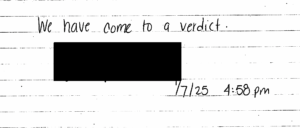
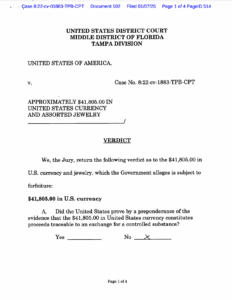
On January 6-7, 2025, Attorney Leslie Sammis took a civil asset forfeiture case to trial in federal court before the Honorable Judge Thomas Barber. The Drug Enforcement Administration (DEA) seized $41,805.00 and about $30,000 in gold jewelry. The property was seized in Manatee County during the execution of a search warrant at our client’s home in late 2021. The case was stayed while the criminal charges were pending. The two-day trial happened on Monday and Tuesday. The jury checked all 9 boxes, “No,” which means the government must return all seized property. It was a total and complete victory.
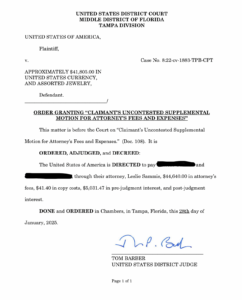
On January 28, 2025, the Court signed an order directing the government to pay the Claimants, through their attorney Leslie Sammis, $44,640.00 in attorney’s fees, $41.40 in copy costs, $5,031.47 in pre-judgment interest, and post-judgment interest. The U.S.A. was required to pay all the Claimant’s reasonable attorney fees, which is mandatory under the Civil Asset Forfeiture Reform Act of 2000 (CAFRA). The mandatory attorney fees provisions are intended to discourage overzealous Government actions in forfeiture cases.
CBP returns $37,000.00 Seized in Jackson County, Mississippi
On December 5, 2024, $37,000.00 was seized from claimant in Jackson County, Mississippi, by U.S. Customs Border Protection (CBP). CBP alleged that claimant violated 21 USC 881(a)(6), 21 USC 881(b) – Proceeds Traceable to Controlled Substances, 18 USC 981(a)(1)(A), 18 USC 1956(c)(7)(A), 18 USC 1961(1)(D), 21 USC 846 – Conspiracy to Commit Violation, and 18 USC 981(a)(1)(A), 18 USC 1956(c)(7)(A), 18 USC 1961(1)(D), 21 USC 841 – Manufacturing, Distributing or Dispensing Controlled Substances. Claimant received a Notice of Seizure and Sammis Law Firm filed a claim for court action on behalf of the claimant, along with the Election of Proceedings. Six months after the seizure, CBP returned all of the seized money.
Florida Highway Patrol Returns Seized Vehicle
On September 27, 2024, the Florida Highway Patrol (FHP) seized a vehicle belonging to claimant. Claimant never received a Notice of Seizure but was served with a Verified Complaint for Probable Cause and for Final Order of Forfeiture where FHP alleged that the forfeiture was pursuant to the Florida Contraband Forfeiture Act (“the Act”), Sections 932.701-7062, Florida Statutes. On behalf of the claimant, Sammis Law Firm filed a demand for Adversarial Preliminary Hearing (APH) and an Answer to the Complaint. Shortly thereafter, FHP filed a Notice of Voluntary Dismissal and returned the vehicle to the claimant.
DEA Returns $46,000.00 seized at the Orlando International Airport
On June 4, 2024, Claimant had $46,000.00 seized at the Orlando International Airport, by the Drug Enforcement Agency (DEA). Claimant received a Notice of Seizure more than eleven (11) months later as DEA initiated the forfeiture action pursuant to 21 U.S.C. 881 and 9 USC §§ 1602-1619, 18 USC § 983 and 28 CFR Parts 8 and 9. Four months after Sammis Law Firm filed a claim for court action on behalf of the claimant, DEA agreed to return the money.
Hillsborough County Sheriff’s Office Files Voluntary Dismissal of Forfeiture Complaint
On August 5, 2024, the Hillsborough County Sheriff’s Office (HCSO) seized $1,420.00 and a vehicle alleging that both were used in violation of the Florida Contraband Forfeiture Act. Sammis Law Firm requested an Adversarial Preliminary Hearing (APH). HCSO agreed to return the money but filed a Verified Complaint for Probable Cause and for Final Order of Forfeiture. Within 21 days, Sammis Law Firm filed and Answer to Verified Complaint. After presenting information about problems with the seizure, HCSO filed a Voluntary Dismissal 15 months later and released the property.
CBP Returns $17,200.00 Seized at the Dallas/Fort Worth Airport
$17,200.00 was seized by U.S. Customs Border Protection (CBP) on November 3, 2024, from claimant and traveling companion at the Dallas/Fort Worth Airport. A receipt was provided to the claimant only but the claimant never received a Notice of Seizure. Four months later, the claimant contacted Sammis Law Firm to file a premature claim. Six months later, CBP returned all of the money seized from the claimant and traveling companion.
Court Finds No Probable Cause for Seizure by Lake County Sheriff’s Office
Leslie Sammis represented two clients (the company that loaded money into an ATM and the bank that supplied the money to the company). In that case, the Lake County Sheriff’s Office seized $42,423,00 in U.S. Currency from one ATM and $89,407 from another ATM.
After an Adversarial Preliminary Hearing held on October 4, 2024, the Court reviewed exhibits, watched a video of the seizure, and listened to the testimony of several witnesses. In an order dated October 4, 2024, Circuit Court Judge Dan R. Mosley found that the Lake County Sheriff’s Office had “no probable cause” to seize the currency found in the ATMs. The property was returned to Ms. Sammis’ clients shortly thereafter.
CBP Releases 1992 Land Rover Defender 110 Imported from South Africa
On April 10, 2024, we received a letter from Robert M. Del Toro, Fines, Penalties and Forfeiture Officer, signed by Rebecca Gabbard, CBP Paralegal Specialist, explaining that our client’s 1992 Land Rover Defender 110, imported from South Africa, seized on 9/20/23, was being returned.
The letter explained that the “Government has decided to release the property to you and return the cost bond.” The letter gave further instructions on picking up the vehicle from a government-contracted facility where it was being held.
Before receiving this letter, we filed a non-CAFRA claim for court action, posted the cash bond, and negotiated with the Assistant United States Attorney (AUSA) while explaining why CBP’s allegations were wrong. Ultimately, the AUSA refused to file a complaint in the U.S. District Court, forcing CBP to release the vehicle immediately.
DEA “Quick Release” under 28 CFR 8.7
On February 6, 2024, more than $20,000 in U.S. Currency was seized for forfeiture at the Jacksonville International Airport. The client hired us the next day. On February 8, 2024, we sent a preservation letter and public record request to the Department of Aviation Security or Internal Auditor at the Jacksonville Aviation Authority (JAA). The letter was to obtain any airport surveillance video showing our client’s initial detention before he was moved to an interrogation room where his luggage was searched and his money was seized. The client also reported that the DEA task force officer seized his cell phone and attempted to delete a video he had taken during his initial detention.
Instead of releasing the surveillance video, the Internal Auditor at JAA forwarded our request to Bradley A. Boyle, Group Supervisor, DEA Jacksonville District Office. Possibly because they didn’t want the video released, the seizing agents indicated they might be willing to release the money if we provided additional documents. We were later contacted by Special Agent John Hollingsworth, DEA Jacksonville District Office, who requested our client sign a DEA-48 (Disposition of Non-Drug Evidence) and Secured Party Indemnity Agreement. That agreement falsely claimed the money had been used in violation of Title 21 of the United States Code. It included a “hold harmless” provision that would have protected DEA from further liability. That proposed agreement also contained language that would have precluded any innocent owner/lienholder defenses if the money were seized again.
When we refused to sign those documents, we received an email from Merri Hankins, Senior Attorney in DEA’s Asset Forfeiture Section, who clarified that “DEA is attempting to return your client’s funds per a procedure referred to as ‘quick release’ found in 28 CFR 8.7.” The quick release was approved even though we had already filed a premature claim on the client’s behalf with DEA on February 20, 2024.
After some negotiation, DEA allowed the client to retrieve all of his money from the sealed evidence bag on March 1, 2024, without signing any of the agreements prepared by DEA.
Court Finds “No Probable Cause” at Adversarial Preliminary Hearing in Broward County
On November 2, 2023, the Honorable Michael Robinson, a Circuit Court Judge in Broward County, signed an order finding “no probable cause” for the seizure and forfeiture of a 2020 Dodge Challenger after an adversarial hearing held on October 30, 2023. The order required the agency to return the vehicle to our client within five (5) business days. Additionally, the order found that since there was no probable cause, the Hollywood Police Department, pursuant to Section 932.704(10), was ordered to reimburse the client for the reasonable attorney fees paid to our firm.
DEA Releases Seized Vehicle After Arrest While Charges Pending
On September 8, 2023, a 2014 Mercedes-Benz G550 was seized by the Drug Enforcement Administration (DEA) during a routine traffic stop, alleging a violation of 21 USC 881, along with violations of other federal laws, including 19 U.S.C. §§ 1602-1619, 18 U.S.C. § 983 and 28 C.F.R. Parts 8 and 9. On behalf of the client, Sammis Law Firm filed a claim for court action with DEA. We presented arguments regarding an illegal stop, detention, and arrest, including the fact that the drug dog did not properly alert. After negotiations with the Assistant United States Attorney (AUSA), the AUSA declined to file a complaint even though criminal charges were pending, and the DEA was forced to release the vehicle back to our client’s mother.
AUSA Returns Cryptocurrency After Forfeiture Complaint Filed
DEA seized over $30,000 worth of U.S. Dollar Tether (USDT) and Bitcoin. After receiving a “notice of seizure,” we filed a verified claim for court action. The AUSA filed a complaint in the U.S. District Court but then agreed to return the property before an answer became due. We entered a memorandum of agreement that ALL of the client’s cryptocurrency would be returned to the client’s wallet within fourteen (14) days. The funds were returned in April of 2023.
DEA Returns $34,082.00 Seized at Orlando International Airport
On June 14, 2023, the Drug Enforcement Agency (DEA) seized $34,082.00 from claimant at the Orlando International Airport alleging that claimant violated 21 U.S.C. 881 and additional federal laws of 19 USC §§ 1602-1619, 18 USC § 983 and 28 CFR Parts 8 and 9. Claimant did not receive a Notice of Seizure from DEA until 19 months after the seizure took place. Claimant then contacted Sammis Law Firm and to file a claim for court action on his behalf. Sammis Law Firm did file a claim for court action on the claimant’s behalf and 3 months after the claim was filed, DEA agreed to return all of the seized money.
AUSA Agrees to Withdraw Seizure Warrant for Bitcoin and USDT in Binance Wallet
Our client’s Binance account was “frozen as it is currently under investigation by law enforcement.” We contacted the Special Agent with the Cyber Group of Homeland Security Investigations (HSI) and the Assistant United States Attorney (AUSA) assigned to the case. The AUSA obtained a seizure warrant but agreed to hold it pending negotiations.
Our client was accused of being an intermediary or a broker of funds stolen from victims of a liquidity mining pool scam in California. We requested a copy of the seizure warrant, supporting affidavit, and account records obtained from Binance. We presented several arguments for why the seizure warrant should be withdrawn, including:
- the U.S. District Court had no jurisdiction over the cryptocurrency funds seized for civil asset forfeiture;
- any accusation that Peer to Peer (P2P) trades constitute a “money transmitting business” was unjustified;
- the fraudulently obtained cryptocurrency was only in our client’s wallet for a short time, so the funds later frozen by Binance were not connected; and
- our client qualified as a “bona fide purchaser” who had no cause to believe that the property was subject to forfeiture.
Shortly thereafter, the AUSA thanked us for providing additional information and indicated that although they believed fraud proceeds were deposited into our client’s wallet, upon further review of our client’s transaction history and the arguments presented, they agreed to withdraw the seizure warrant by seeking the appropriate order from the issuing magistrate and promptly communicating any withdrawal order to Binance.
DEA Returns $23,700.00 Seized at Miami International Airport
The Drug Enforcement Agency (DEA) seized $23,700.00 from claimant at the Miami International Airport on August 11, 2022. DEA alleged that the claimant violated 21 U.S.C. 881 and additional federal laws of 19 USC §§ 1602-1619, 18 USC § 983 and 28 CFR Parts 8 and 9. Claimant did not receive a Notice of Seizure until 31 months after the seizure occurred. Claimant contacted Sammis Law Firm to file a claim for court action on claimant’s behalf. Two months after the claim was filed, DEA agreed to return the seized money with interest.
CBP Returns More than $10,000 Seized at the Fort Lauderdale International Airport
On 3/3/22, we received an email and letter from SAMANTHA J GAROFALO for Amelia Castelli, Director, Fines, Penalties and Forfeitures, Office of Field Operations, CBP, Miami, FL, in response to a verified claim we served on CBP on 11/5/21. The letter indicated that more than $10,000 in U.S. Currency seized at the Fort Lauderdale International Airport on September 09, 2021, by an agent with U.S. Customs and Border Protection (CBP) would be released to us via a check. CBP agreed to refund 100% of the money seized after the Assistant United States Attorney decided not to file a complaint in the U.S. District Court to litigate the forfeiture issue.
CBP Returns $22,000 Seized at Bradley International Airport, Windsor Locks, CT
On 1/20/22, we received notice from CBP that it was returning more than $22,000 seized from our client at the Bradley International Airport, Windsor Locks, in Hartford County, CT. We filed a verified claim for court action to bypass the administrative procedure for remission or mitigation. We also filed a demand to preserve the surveillance video and obtain the seizing agent’s investigation report from Homeland Security Investigations. Based on the report, we showed the AUSA several problems with the seizure, including:
- The K9 provided a “false positive” alert since no narcotics were found, and the agent didn’t bother to actually test for any trace narcotics on the currency before depositing the money into the bank.
- The amount seized is not a particularly large amount of U.S. Currency, especially for someone in our client’s position, given his income and net worth.
- TSA has no business monitoring and detaining passengers for carrying U.S. currency, especially for just over $28,000.
- The initial detention by TSA, which was illegal from its inception, was prolonged for an even longer period of time by the HSI agent as it attempted to gather enough highly circumstantial “evidence” to meet its interpretation of the probable cause standard.
- The seizing agent had no search warrant or legal basis to open the luggage or observe the money.
- No free and voluntary consent for the search was given under those circumstances.
- None of the client’s statements were actually contradictory. Instead, the agents kept asking the same questions over and over again.
- The client’s explanation that he intended to use the money to buy a vehicle was reasonable and supported by the evidence presented.
CBP Returns $14,802.00 Seized at the Fort Lauderdale International Airport
On August 16, 2021, we received a letter signed by Graciela B. Espinoza for Robert M. Del Toro, the Director of Fines, Penalties and Forfeitures at the U.S. CBP FPF Office, informing us that the $14,802.00 seized from our two clients before an international flight at the Fort Lauderdale International Airport on February 16, 2021, would be returned. The letter also provided: “The Government has decided to release the property to you.”
We filed a claim on April 12, 2021, which was signed by each client. The claim showed that $6,376 was seized from one client, and $8,426 was signed by the other client by a CBP Agent. The money was combined into one pile by CBP, who then issued only one receipt.
After being contacted by the Senior Attorney with the Office of the Associate Chief Counsel (Miami) for U.S. Customs and Border Protection, we argued that the CBP agents improperly combined the money. We also showed that CBP agents improperly alleged that our clients had more than $10,000 on an international flight after structuring the money to evade the reporting requirement pursuant to Title 31, United States Code, Section 5324 or the FinCEN 105 form by knowingly dividing the currency between themselves so that each was transporting less than $10,000 from a place inside the United States to a place outside of the United States.
CBP Returns $57,000 Seized at the Tampa International Airport
In January 2021, CBP seized $57,000 from a traveler at the Tampa International Airport. Before attempting to board a domestic flight, the traveler was detained and questioned near Gate A. Shortly thereafter, the traveler was escorted to the Tampa International Airport Police Station, where the detention continued for more than three hours. The traveler’s $57,000 was eventually seized, and the receipt listed an “undisclosed amount” of U.S. Currency.
Immediately after we were retained, we filed a claim for court action and preserved all video from Gate A and the police station. We convinced CBP to return all the $57,000.00 after showing problems with the legality of the warrantless search and prolonged detention.
FBI Returns $24,905.00 Seized for Forfeiture at the Airport in San Juan, Puerto Rico
On September 17, 2020, FBI agents seized $24,905.00 in United States Currency from our client at the Luis Munoz Marin International Airport in San Juan, Puerto Rico. According to the receipt, the money was seized for forfeiture pursuant to 21 U.S.C. 881. We filed a verified claim online on January 4, 2021.
The Assistant United States Attorney then waited 92 days to file a Verified Complaint for Forfeiture In Rem. After showing proof to the AUSA that the complaint was filed outside of the 90-day deadline imposed by CAFRA, the FBI agreed to return 100% of the money seized to our office. On May 6, 2021, the AUSA then filed a voluntary dismissal of the complaint with prejudice pursuant to Federal Rule of Civil Procedure 41(a)(1)(A)(i).
Keep in mind that you are not required to fill out a FinCEN Form 105 if you bring more than $10,000 cash into or out of Puerto Rico or the Luis Munoz Marin International Airport since it is not classified as “outside of the United States” or “a foreign country” for purposes of the reporting requirements (the same is true for the U.S. Virgin Islands, Guam, American Samoa, the Northern Mariana Islands, and Territory of the Pacific Islands).
Although you can carry over $10,000 cash on a flight to Puerto Rico or the U.S. Virgin Islands without needing to fill out a FinCEN Form 105, federal agents monitor individuals traveling to those locations more carefully, especially when they are suspected of transporting bulk currency.
CBP at DFW Airport to Return $30,830.00 After AUSA Files the Complaint
On October 18, 2020, an agent with Customs and Border Protection (CBP) seized $30,830.00 from our client at the Dallas/Ft. Worth (DFW) Airport. Before hiring our firm, the client attempted to file a pro se claim, but received correspondence from D.M. Nichols, Fines, Penalties & Forfeiture Officer and Paralegal Specialist Steven M. McGuirk at the Dallas/Ft. Worth Airport.
The letter claimed that the initial claim filed by the client on a pro se basis appeared to be “in conflict” about whether an administrative or judicial proceeding was being requested. After we were retained, we filed a second verified claim for court action on the client’s behalf, which CBP received on December 30, 2020.
More than 90 days later, the Assistant United States Attorney (AUSA) filed a complaint for forfeiture in the Dallas Division of the Northern District of Texas Dallas. We provided proof that the 90 day CAFRA deadline was missed. CPB agreed to return the money and the AUSA then filed a Motion for Voluntary Dismissal with prejudice pursuant to Fed. R. Civ. R. 41(a)(1)(A)(i). The motion explained:
“This dismissal is based on the untimely nature of the complaint, filed more than 90 days after an initial claim was made to Customs and Border Patrol for the $30,830 in question. Plaintiff has spoken with counsel for the Claimant of the $30,830 and understands there are no objections to this dismissal.”
DEA Seized +$78,000 at the JFK International Airport and Returned All of the Funds
In October 2020, DEA seized more than $78,000 from a traveler at the JFK International Airport. After we were retained, we took steps to preserve any surveillance video of the initial detention. After filing a verified claim for court action, a Senior Law Clerk with the Forfeiture Support Associates, LLC, contacted us to find out whether we would be amenable to a CAFRA extension to see if the case could be resolved prior to the filing of a complaint. We declined this invitation but provided information showing problems with how the initial detention occurred. We were then contacted by an Assistant United States Attorney (AUSA) with the Asset Forfeiture Unit in the Eastern District of New York. Ultimately, the AUSA failed to file the complaint within the 90 day deadline, and the funds were returned shortly thereafter.
DEA Seized $18,000 at the Jacksonville International Airport and Returned $18,000
In October 2020, the DEA seized $18,000 from a traveler at the Jacksonville International Airport. Shortly after being retained, we took steps to preserve the video of the initial detention from the JAA Internal Auditor. We then filed a verified claim for court action. After the Assistant United States Attorney failed to file a complaint for forfeiture within the 90 day deadline, all seized funds were returned in April of 2021.
DEA Seizes +$36,000 at the JFK Airport and Returns All of the Funds
In October 2020, a DEA Special Agent seized more than $36,000 from our client at the JFK International Airport. We took steps to preserve the video of our client’s initial detention by TSA at the checkpoint and later detention by DEA at the gate. After filing a verified claim for court action, we were contacted by an Assistant United States Attorney (AUSA) at the Asset Forfeiture Unit for the Eastern District of New York. After showing problems with the legality of the initial detention, the AUSA failed to file a complaint within the 90-day deadline, and the DEA returned the seized funds shortly thereafter.
DEA Returns $47,000 Seized at the Newark Liberty International Airport
In September of 2020, DEA seized $47,000 from our client at the Newark Liberty International Airport. Shortly after we were retained, we took steps to preserve any surveillance video of the initial detention from the Port Authority. We then filed a verified claim for court action and provided information about problems with the legality of the initial detention. The Assistant United States Attorney decided not to file a complaint within the 90 day deadline. The funds were returned shortly thereafter.
CBP Seized $17,280 at the Orlando Airport and Returns $17,280
In September of 2020, agents with CBP seized $17,280 from a traveler at the Orlando International Airport. Shortly after we were retained, we preserved all of the surveillance videos of the initial detention from the Orlando Aviation Authority. After filing a verified claim, we presented information to CBP about the illegality of the initial detention, search, and seizure. The CBP ultimately decided to return all of the funds seized.
CBP Returns $17,000 of the $18,442.00 Seized at the San Ysidro Border Crossing
In September of 2020, CBP seized $18,442.00 at the San Ysidro Border Crossing near San Diego, California. Shortly after being retained, we filed a verified claim. Shortly after filing the claim, we were contacted by a Senior Attorney with CBP’s Office of Assistant Chief Counsel. Based on the documents we submitted, CBP’s Senior Attorney agreed that the circumstances justified a pre-civil settlement in which $17,000 would be refunded to our clients.
According to U.S. Customs and Border Protection (CBP) records, our clients, a husband and wife, were questioned as they were departing the United States at the San Ysidro Border Crossing. In response to being asked whether either was transporting more than $10,000 in U.S. currency or monetary instruments, each reported carrying $8,000. Upon further inspection, officers discovered a total of $18,442, which CBP claimed belonged to the husband. CBP alleged that the husband divided the money to avoid the currency reporting requirement.
The CBP officers claimed they didn’t need probable cause, nor reasonable suspicion to search persons, baggage, or conveyances crossing the international border for either inbound and outbound border crossings. The currency in this case was not seized with regard to its source and/or use. Rather, it was seized for non-compliance with 31 U.S.C. 5316, which requires an individual to report the transportation of currency over $10,000.00.
Willful failure to report the actual amount over $10,000 in currency is a crime punishable by up to five years in prison, a $250,000 fine, and forfeiture of the currency. (See 31 U.S.C. 5317 & 5322.) Dividing money among multiple travelers so that no single traveler is carrying more than $10,000, is in fact a separate crime commonly known as structuring, and is punishable by up to five years in prison, and a $250,000 fine. (See 31 U.S.C. 5324.)
Nevertheless, neither of our clients were charged with a crime and CBP agreed to return $17,000 to them on February 8, 2021, if they agreed to withdraw their requests that judicial forfeiture proceedings be commenced against the Currency. The balance of $1,442 was retained by the government as a payment in lieu of forfeiture.
CBP Returns $40,253 During Traffic Stop
In September of 2020, officers with the Brevard County Sheriff’s Office and agents with Customs and Border Protection (CBP) seized $40,253 in U.S. Currency discovered during a routine traffic stop and arrest on an outstanding warrant. After preserving video and audio from the roadside investigation and at the police station, we filed a verified claim for court action on October 20, 2020, which triggered the 90 day deadline for the Assistant United States Attorney (AUSA) to file a complaint in the U.S. District Court. Instead of filing the complaint, on February 2, 2021, we received a letter from CBP that indicated: “After a review of the matter, the Government has decided to release the property to you.”
CBP $48,660 Seized at the Orlando Airport and $48,660 was Returned 115 Days Later
On December 7, 2020, we received a letter from the Fines, Penalties and Forfeiture Officer concerning $48,660 in U.S. Currency that was seized at the Orlando Airport in September of 2020. The letter explains that “[a]fter review of the matter, the Government has decided to release the property to you.” The refund through direct deposit arrived on January 15, 2021.
In this case, we preserved surveillance video from the Orlando International Airport showing the problems with the detention from its inception. We also gathered all of the evidence showing why the funds came from a legitimate source and were intended for a legitimate purpose.
CBP Agrees to Return $13,522 after Seizing $13,522 in Detroit, MI
In July of 2020, CBP agents seized $13,522 from a husband and wife who were traveling together for an international flight out of the Detroit Metropolitan Airport. Normally, you do not need to declare on the FinCEN 105 form the amount of cash that you are bringing into or out of the United States on an international flight unless you are carrying more than $10,000.
Although neither of them had more than $10,000 in their possession, CBP seized the money after alleging that the husband and wife distributed the money between them with the intent to evade the currency reporting requirement of Title 31, United States Code, Section 5316. After filing the verified claim for court action and showing all of the reasons that the seizure was unjustified, on October 16, 2020, we learned that the AUSA decided not to file a complaint. The check arrived on November 19, 2020.
CBP Agrees to Release 100% of more than $40,000 Seized in Brevard County by ICE Agents
On November 9, 2020, we received a letter of “Judicial Forfeiture Declination” from Robert M. Del Toro, the Fines, Penalties & Forfeitures Officer with the Department of Homeland Security, U.S. Customs and Border Protection, Office Field Operations in Tampa, FL, regarding the seizure of more than $40,000.00 in U.S. Currency that U.S. Immigration and Customs Enforcement (ICE) seized in Brevard County, FL, after a routine traffic stop.
Immediately after the seizure, we filed a claim demanding court action and judicial referral. We also acted quickly to preserve video surveillance that showed problems with the way the money was seized. After a review of the matter, the Government decided to release the property instead of filing a complaint for forfeiture in the U.S. District Court.
$14,826 Seized by Homeland Security at the Dallas/Fort Worth (DFW) Airport and 100% Returned within 6 Months
On Tuesday, October 13, 2020, we received a letter from Paralegal Steven M. McGuirk on behalf of D.M. Nichols, Fines, Penalties and Forfeitures Officer at the U.S. Customs and Border Protection Office at 7501 Ester Blvd., Suite 160, Irving, TX 75063, that the “Government has decided to release the property to your client.”
A few days earlier, the Assistant U.S. Attorney with USAO-NDTX Asset Recovery, in Dallas, TX, told us that he “declined to pursue court action in the forfeiture case.” As a result, CBP was required to immediately return 100% of the $14,826 in U.S. Currency seized at the Dallas/Fort Worth Airport (DFW Airport).
Just a few weeks prior to that decision, the AUSA made an offer to return only $2,826 to our client with $12,000 being forfeited to the government. We quickly rejected that offer.
The seizure of currency by DEA at the Dallas/Fort Worth (DFW) Airport involved task force officers with the Drug Enforcement Administration (DEA) Homeland Security Investigations (HSI), HSI IRS Special agents, a DFW Police CID Detective, a Tarrant County Narcotics Detective, and/or K9 drug dogs. The law enforcement officers at the airport in Dallas/Fort Worth, TX, might report conducting “passenger interdiction as part of an ongoing bulk cash smuggling initiative” by making “consensual encounters with random individuals.”
But in many of these cases, a TSA agent secretly provides them with a tip that a traveler is carrying a large amount of U.S. currency. After reviewing the written reports generated during the investigation and gathering additional evidence, we provided the AUSA with all of the reasons that the initial detention was illegal.
The check for $14,826.00 arrived in our office on November 9, 2020.
$16,563 Seized by Homeland Security and $16,563 Returned within Four (4) Months
On November 27, 2019, before boarding an international flight out of the Tampa International Airport, an agent with U.S. Homeland Security Investigations (HSI) seized $16,563.00 from our client because the unreported currency was not listed on a FinCEN Form 105.
Although most of these types of seizures go unchallenged, our client found us by searching from his cell phone and contacted the firm while he was still at the airport after the seizure. We immediately preserved the airport surveillance video and filed a verified claim for court action to bypass any administrative proceeding.
On February 28, 2020, we received a letter from Robert M. Del Toro, the Fines, Penalties & Forfeitures Officer for the U.S. Customs and Border Protection (CBP) in Tampa, FL. The letter indicated that CBP received all of our correspondence regarding the seizure of $16,563.00 in U.S. Currency, including the demand for court action.
The letter indicated that “[a]fter a full review of the matter, it has been determined that the seized currency will be returned. Therefore, we have initiated a full refund which will be paid through the National Finance Center… You may expect this payment in approximately 2-3 weeks from the date of this letter.”
Most airports do not post adequate signs or make announcements about the currency reporting requirement for travelers departing the United States on an international flight. Even if the traveler somehow knew about the requirement, being able to comply would be onerous. As a result, seizures of unreported U.S. Currency not listed on the FinCEN Form 105 are common.
$159,950 Plus Interest Returned by Homeland Security
On September 20, 2019, $181,500.00 in U.S. Currency was seized at the Tampa International Airport before a domestic flight. A federal agent wrote a receipt to our client that said: “MONEY CONTAINED IN 2 BAGS. ESTIMATED VALUE IS 181,500.00.” However, only $159,950 was deposited into the bank after the seizure.
On September 26, 2019, we sent a claim via Certified Mail Return Receipt Requested to Fines, Penalties, & Forfeitures Officer, with the U.S. Customs and Border Protection in Tampa, FL., for the $181,500.00 in U.S. Currency.
Without acknowledging the claim, on October 9, 2019, Robert Del Toro, Fines, Penalties, & Forfeitures Officer with CBP send a notice of seizure claiming that only $159,950 has been seized. We filed a verified second claim for the funds listed in the “notice of seizure.”
After not reaching a resolution with the Assistant United States Attorney for the timely return of the funds, we file a lawsuit against CBP in federal court on January 31, 2020. We agree to voluntarily dismiss the lawsuit against CBP after it returned $159,950 and agreed to return an additional amount for interest in a second check.
Homeland Security Seizes $63,490.00 and Returned the Entire Amount After Filing a Complaint
In September of 2019, our client was detained at the Orlando International Airport (OIA). After finding $63,490 in U.S. currency in a checked bag, federal agents with the Department of Homeland Security seized the bag without a warrant. The agents then located our client who was boarding the domestic flight.
After being removed from the flight and enduring a prolonged detention, the client signed a “notice of abandonment and assent to forfeiture of prohibited or seized merchandise” form 4607 which was witnesses by a special agent with Homeland Security Investigations (HSI).
On October 11, 2019, we filed a claim for early judicial intervention or court action. The AUSA assigned to the case didn’t file the complaint until January 15, 2019. The verified complaint for forfeiture in rem alleged that the law enforcement officers seized the currency because there was probable cause to believe that the Defendant Funds constituted:
- Money furnished or intended to be furnished by a person in exchange for a controlled substance in violation of the Controlled Substances Act;
- Proceeds traceable to such an exchange; or
- Money used or intended to be used to facilitate a violation of the Controlled Substances Act.
After showing the AUSA our basis for having the case dismissed, the AUSA filed for Voluntary Dismissal which was granted on February 5, 2020. We received a check for the entire $63,490.00 on February 24, 2020, which was approximately 5 months after the seizure of cash from the Orlando International Airport.
U.S. Customs and Border Protection (CBP) Agrees to Return $45,001 after Airport Seizure of $45,001
On September 8, 2019, federal agents with the Department of Homeland Security (DHS) seized $45,001.00 in U.S. currency from our client’s luggage. We were contacted by a local attorney who took the case initially but wanted to be co-counsel with our law firm on the case.
The client signed an agreement to retain our firm under those terms. After completing our preliminary investigation, talking with the agent that seized the money, and preserving video surveillance of the incident, we filed a verified claim on September 30, 2019.
Our first verified claim letter demanded early judicial intervention (also called “court action”). We also provided additional information about the legality of the seizure and demanded that the case be forwarded to the United States Attorney’s Office to avoid any further delay.
Our first verified claim triggered the Fines, Penalties and Forfeiture Officer with the U.S. Customs and Board Protection to send the Notice of Seizure and Information to Claimants CAFRA Form, the Election of Proceedings CAFRA Form, and the Seized Asset Claim Form to us on October 4, 2019.
In response to those documents, we send a second demand for early judicial intervention (“court action”) on October 31, 2019.
Within 90 days of our first verified claim letter, we received a certified letter from the FP&F Officer. The letter explained: “The determination has been made that $45,001.00 will be remitted.” The check for $45,001.00 arrived on February 7, 2020.
DEA Seizes $52,620 and Agrees to a Full Refund 6 Months Later
On October 30, 2018, DEA seized $52,620.00 at the Fort Lauderdale-Hollywood International Airport in Broward County, FL, from our client. We immediately filed a claim to contest the forfeiture in the United States District Court pursuant to 18 U.S.C. Section 983, et. seq, 19 U.S.C. Sections 1602-1619, Title 21 CFR Sections 1316.71-1316.81.
On February 6, 2019, we receive a letter from the DEA’s Office of Operations Management of the Asset Forfeiture Section acknowledging that it received the submission of the claim. The claim was accepted and the matter was referred to the United States Attorney for the Civil Division in the Southern District of Florida.
After sending various financial documents to the AUSA assigned to the case, we were able to show a legitimate source of the funds. We also provided information about technical and procedural problems that impacted the AUSA being able to file a complaint.
On April 22, 2019, we received a letter informing us of the “decision to return” the entire $52,620.
CBP Returns $30,000 after $30,000 in U.S. Currency Seized at Tampa International Airport
On December 12, 2018, agents with U.S. Customs and Border Protection (CBP) seized $30,000 in cash at the Tampa International Airport from our client without providing a receipt. A few days later we requested a receipt showing that $30,000 had been taken.
The authorities confirmed that an undetermined amount of currency was seized but claimed it had not yet been counted. Eventually we were provided with a receipt from CBP which correctly listed the total of $30,000 in U.S. Currency being seized.
Shortly after the seizure, we preserved the airport surveillance video of the agents who conducted the initial interrogation, search, and seizure. Because part of the detention of the seized cash occurred at the Tampa International Airport Police Department (TIAPD), we also preserved the surveillance video of that part of the detention.
On January 1, 2019, we created an election of proceedings form and verified CAFRA seized asset claim to trigger the case be forwarded to the U.S. Attorney’s Office for early judicial action.
We received a letter dated March 16, 2019, from the Fines, Penalties and Forfeitures Officer for U.S. Customs and Border Protection which indicated that “[a]fter a full review of this matter, our office determined that the currency will be returned to your client. Therefore, $30,000 in U.S. currency will be returned to [your client] within three to four weeks.”
We agreed to complete a CAFRA Hold Harmless Release Agreement in consideration for the return of all of the property. The form required our client to forever release the United States from any claim in connection with the detention, seizure, and/or release by U.S. Customs and Border Protection of the above-listed property.
The agreement also required our client to waive any claim to attorney’s fees, interest, or any other relief not specifically provided for in the agreement. We finally received the check for $30,000 on April 19, 2019.
$30,000.00 Seized by DEA at the Airport and $29,375.89 Refunded
On April 14, 2018, several DEA agents seized $30,000 in cash from our client. Immediately after the seizure, the DEA issued our client a “receipt for cash or other items” which listed an “undetermined amount of US Currency.” The DEA agents then sealed the cash in a bag and took it to the bank to be deposited.
On June 7, 2018, the DEA send our client a “notice of seizure of property and initiation of administrative forfeiture proceedings” which described the property as $29,000 in U.S. Currency. $1,000 went missing.
On July 11, 2018, we send via “federal express priority overnight” a claim to contest the forfeiture of the property in U.S. District Court (a request for immediate judicial action). Our claim forced the DEA to stop the administrative forfeiture proceeding and forward the case to the U.S. Attorney’s Office for further proceedings.
Because of several problems that we pointed out, the U.S. Attorney’s Office refused to take any action in the case. Shortly thereafter, we received a letter dated November 15, 2018, from the Senior Attorney with the Asset Forfeiture Section of the DEA informing us of the decision “to return” the $29,000. We competed the UFMS Vendor Request Form as requested.
On December 20, 2018, we received the check for $29,375.89.
DEA seized $13,260 Cash at the Orlando International Airport and $13,260 Returned
On June 13, 2018, DEA seized $13,260 from our client at the Orlando International Airport. That same amount was deposited into the bank by the DEA agents. After we were retained in the case, we submitted a packet of information including a verified claim for judicial court action before the deadline on August 28, 2018.
On September 20, 2018, Merri L. Hankins, Senior Attorney for the DEA’s Asset Forfeiture Section wrote us a letter informing us of the decision to return the $13,260 in U.S. Currency.
$13,227 Seized by ICE HSI and $11,892 Returned
U.S. Currency was seized from our client at the Tampa International Airport. The receipt provided to the client by Homeland Security Investigations (“HSI”) Special Agent (“SA”) Carlos Carrasquillo indicated that “$13,227” had been seized and the currency was counted in the client’s presence before the receipt was written. Nevertheless, only $11,892 was actually deposited into the bank by ICE HSI agents.
We immediately filed a verified demand for early judicial court action and complained about the missing money. Shortly thereafter, we received a letter from Mary Ann Cranford, with the title “Fines, Penalties, & Forfeitures Officer” at the U.S. Customs and Board Protection Office in Tampa dated April 6, 2016.
The letter indicated that Mary Ann Cranford had received our verified claim demanding the immediate return of funds taken by Homeland Security Investigations (“HSI”) Special Agent (“SA”) Carlos Carrasquillo at the Tampa International Airport.
The letter advised that the U.S. Attorney’s Office has chosen not to file a forfeiture action in Court. The letter stated: “Accordingly, this office will submit a request to the National Finance Center to issue a refund in the amount of $11,892” which was the total amount presented to the CBP office after the seizure.
This article was last updated on Wednesday, March 20, 2024.