


Problems with Heuristics in Crypto Tracing
The term “heuristic” is generally defined as a practical rule or problem-solving shortcut. In the context of cryptocurrency forensics, however, government-reliance on heuristics creates a dangerous dual-front problem for criminal defense attorneys. First, the prosecution frequently attempts to hide these analytical shortcuts behind a “black box” of proprietary privilege or protective orders. Second, the underlying methodologies are often structurally unverified, demanding aggressive exclusion under Daubert and Federal Rule of Evidence 702.
The battleground for this technical skirmish is perfectly captured in United States v. Sterlingov, 719 F. Supp. 3d 65 (D.D.C. 2024)—one of the first criminal cases focused on blockchain tracing to proceed to trial in the United States, and a foundational benchmark for Daubert challenges to digital asset forensics.
While the Sterlingov court ultimately concluded that the government proved by a preponderance of the evidence that Chainalysis Reactor is the product of reliable principles, the litigation exposed the deep systemic flaws inherent in automated software clustering.
Heuristics Black Box Problem: State-Sanctioned Secrecy
The first hurdle for the defense is simply gaining access to the logic under the hood. Government experts routinely deploy third-party software like Chainalysis Reactor or TRM Labs to cluster thousands of disparate blockchain addresses into a single attributed entity. Yet, the specific parameters governing these algorithms are closely guarded corporate secrets.
In an earlier ruling in the same case, United States v. Sterlingov, 704 F. Supp. 3d 176 (D.D.C. 2023), the government successfully sought a protective order to heavily restrict the defense from reviewing “sensitive, supplemental heuristic information.” The prosecution argued that revealing exactly how behavioral heuristics are implemented, weighted, and—crucially—what behavior triggers a “kickout” (preventing a cluster) would allow bad actors to evade detection.
By granting these orders, courts force defense counsel to cross-examine an expert witness on conclusions drawn from an algorithm whose precise logic, thresholds, and systemic biases remain legally shielded from comprehensive public or independent peer review.
The Validation Problem: Deconstructing the Big Three Heuristics
To effectively challenge software-driven attributions, practitioners must look at the specific assumptions underlying the software’s architecture. As detailed in Sterlingov, Chainalysis primarily relies on three categories of heuristics to link pseudo-anonymous addresses to real-world targets.
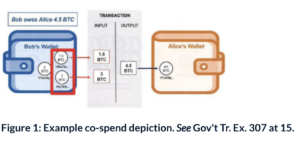
Heuristic 1: The Co-Spend / Common Spend Assumption
The oldest and most common shortcut relies on multi-input transactions. Rooted in Satoshi Nakamoto’s foundational 2008 Bitcoin White Paper, the premise is simple: if a single transaction requires inputs from multiple addresses, the sender must possess the private keys for all of them. Therefore, a single entity likely controls all those addresses.
This assumption completely breaks down in the presence of privacy-preserving protocols like CoinJoin (e.g., Wasabi Wallet), where multiple completely unrelated users intentionally combine their inputs into a single transaction to obfuscate ownership. While analytics firms assert they have “controls in place” to skip CoinJoin transactions, these filters are proprietary and prone to false negatives.
Heuristic 2: Behavioral Fingerprinting and Peel Chains
Large-scale blockchain entities (like darknet marketplaces or exchanges) rely on automated scripts to manage their volume. This creates distinct, predictable digital fingerprints on the public ledger. Heuristic 2 tracks custom rule-sets based on:
- Wallet Architecture: How a specific software wallet uniquely handles mining fees or selects “change addresses” (temporary addresses created to receive unspent transaction remnants).
- Temporal Patterns: Transaction sizes, script characteristics, and “lock times” (parameters scheduling a minimum time before a blockchain accepts a transaction).
- Peel Chain Behavior: A distinct pattern occurring when a wallet receives a large amount of cryptocurrency and gradually “peels” it off via small, sequential transactions.
Behavioral fingerprinting is circumstantial, correlative, and highly susceptible to changing software updates or deliberate mimicking by third parties.
Heuristic 3: Unique Identifiers and Attribution
The third metric relies on tags and markers that forensic firms claim to have manually or independently tied to specific virtual asset service providers (VASPs) or illicit platforms in the past. Although the Sterlingov court rejected the defense’s “junk science” characterization—noting that Chainalysis Reactor’s methodologies were “highly reliable, and if anything, conservative”—it left a vital door open for defense attorneys:
“The defense, of course, remains free to challenge the accuracy and reliability of Reactor before the jury.” — Sterlingov, 719 F. Supp. 3d at 85.
The court itself acknowledged that much of this tracing can be independently verified or challenged with “public blockchain data, a pad of paper, a pencil, and hours of work.”
To win these battles moving forward, the defense must dismantle the illusion of mathematical certainty presented by prosecution experts. By exposing the lack of a centralized, documented error rate, forcing disclosure of false-positive “kickouts,” and highlighting the disruptive impact of mixing protocols, counsel can transform a seemingly bulletproof software attribution into what it actually is: a series of educated, unverified corporate guesses.
This article was last updated on Monday, June 8, 2026.