




When is a Hearing Required to Seal or Expunge a Criminal Record?
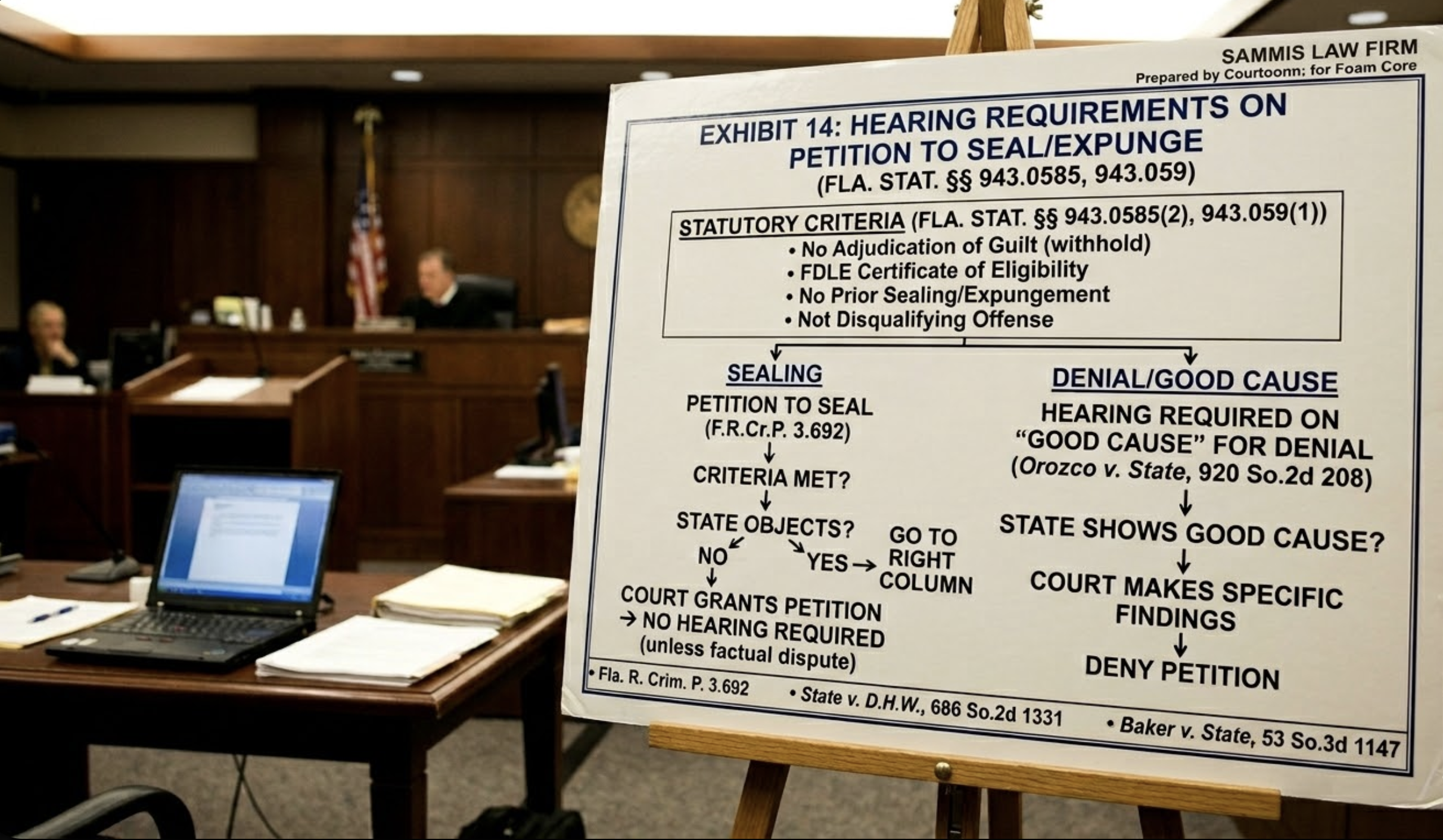
For many Floridians seeking a “second chance,” the process of sealing a criminal record feels like a bureaucratic hurdle. One of the most common points of confusion for both petitioners and practitioners is whether a formal court hearing is actually required to get a petition granted.
Under Florida law, the answer depends largely on whether the court intends to grant or deny the petition, and whether the petitioner has met the baseline statutory requirements.
The Presumption of Entitlement
In Florida, sealing and expungement are governed by Florida Statutes §§ 943.059 and 943.0585, respectively. If a petitioner meets the strict statutory criteria—such as obtaining a certificate of eligibility from the FDLE and ensuring they have no prior adjudications of guilt—they are often considered presumptively entitled to relief.
As noted in State v. T.A., 27 Fla. L. Weekly Supp. 553a (2019), the court relies on Florida Rule of Criminal Procedure 3.692 to balance public policy concerns. While the court may receive evidence on any issue of fact, it is not always obligated to do so.
Based on Florida case law, the requirements for a hearing to decide a petition to seal or expunge a criminal record break down into two categories:
Action by the Court
Is a Hearing Required?
Legal Reasoning< Granting a Petition No If the petitioner meets all statutory criteria and the court finds no "good reason" to deny it, the court may grant the petition based solely on the written record. Denying a Petition Yes A court cannot deny a petition based solely on "generalized considerations" or unproven allegations in a probable cause affidavit. It must hold an evidentiary hearing to provide a "sound reason" for the denial. In State v. T.A., 27 Fla. L. Weekly Supp. 553a (2019), the court considered the prosecutor’s contention that even though the current version of section 16 of Article I of the Constitution of the State of Florida (“Marsy’s Law”) does not specifically confer to an alleged victim the right to be heard during the Court’s consideration of a petition to seal under section 943.059, Marsy’s Law did not eliminate a victim’s existing right to be heard. Nevertheless, since there was no existing right to be heard, the court could still grant the petition without a hearing. For that reason, the alleged victim had no right to be heard if the court intended to grant the petition without a hearing.
>The State’s Objection: Does it Force a Hearing?
A common tactic by the State is to object to a sealing petition and request a hearing to present “good cause” for denial. But the mere request for a hearing by the State does not automatically trigger any requirement for the court to conduct one.
The court holds the discretion to grant a petition without a hearing even in the face of a State objection, provided the written record supports the petitioner’s entitlement. In other words, the court is not required to conduct a hearing when it grants a petition, but only when it intends to deny one to ensure the defendant receives a “meaningful review.”
In some jurisdictions and courtrooms within that jurisdiction, the courts routinely set a petition for sealing or expunction for hearing. In other jurisdictions, the court rarely sets a petition for sealing or expunction for hearing unless requested by the state. Some courts require a hearing to seal or expunge a felony record, but not a misdemeanor record. In other words, different jurisdictions have different procedures that vary widely.
In State v. T.A., 27 Fla. L. Weekly Supp. 553a (2019), the court explained why a hearing is not required if it intends to grant the motion to seal or expunge.
Read more about sealing or expunction of a criminal record in Florida. Or contact us to find out more about the best way to seal or expunge. Call 813-250-0500.