




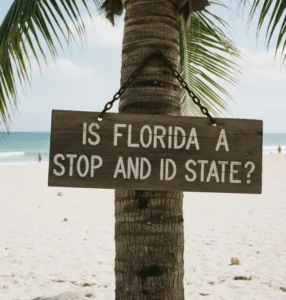
Is Florida a Stop and ID State?
Yes, Florida is generally considered a “stop and ID” state based on the interaction between the following statutes:
- “Stop and Frisk Law” found at Fla. Stat. §901.151
- “Loitering and Prowling” statute found at Fla. Stat. §856.021(2)
Because of the interaction between these two statutes, a person might be required to identify themselves when requested by a law enforcement officer, but only if that officer reasonably suspects that a crime has been committed, is being committed, or is about to be committed.
For this reason, Florida law makes it difficult to list the reasons you might have an obligation to provide your name to an officer. Why does it matter? The evidence gathered illegally might be suppressed if the officer’s detention or request violates the Fourth Amendment’s prohibition on unreasonable searches and seizures. The distinction, however, does little to help a person deal with law enforcement officers during an unlawful detention.
In Terry v. Ohio, 392 U.S. 1 (1968), the U.S. Supreme Court found the U.S. Constitution allowed a police officer to temporarily detain a person based on “specific and articulable facts” establishing reasonable suspicion that a crime has been committed, is being committed, or is about to be committed. The U.S. Supreme Court extended that holding by finding that a statute requiring a suspect to disclose their name during a valid Terry stop did not violate the Fourth Amendment in Hiibel v. Sixth Judicial District Court of Nevada, 542 U.S. 177 (2004).
Some stop-and-identify statutes are unconstitutional under the void for vagueness doctrine when the statutory language is unclear on how a person must identify themselves when requested. Other problems include whether a person can refuse to identify themselves if doing so would be incriminating.
Generally, you are not necessarily required to show a photo identification card or driver’s license because stating your full name and date of birth is often deemed sufficient. But an attorney can give no good advice on this topic because of the variables involved in a typical detention. For that reason, nothing in this article is advice.
Problems With Refusing to Identify Yourself or Show Your ID
The information listed here should not be relied on when interacting with law enforcement. Instead, this article is intended to help you spot issues that might exist in your case if you were illegally detained in the past. Most of these issues can only be determined by the court in a hearing on a motion to suppress long after the detention has ended.
As a practical matter, asserting the right to refuse to identify yourself is difficult for the following three reasons:
- First, it is difficult to tell whether the request for your name and identification is being made during a consensual encounter or as part of a detention.
- For this reason, people sometimes say: “I don’t answer questions. Am I free to go?”
- Second, the officer usually has no obligation to tell you the basis of their suspicion.
- Instead, if you are illegally detained, and evidence is gathered due to that illegal detention, your attorney should file a motion to suppress that evidence.
- At a hearing on the motion, the prosecutor would then have the burden of presenting evidence showing a legal basis for the stop, detention, and request for identification.
- Third, if you refuse to identify yourself, that refusal might support the probable cause to arrest you for “loitering and prowling.”
- Although a warrantless arrest for most misdemeanors requires that each element of the crime was committed in the officer’s presence, an exception was created for more than 20 misdemeanors, including any criminal act under § 856.021 for loitering and prowling. See Fla. Stat. § 856.031.
Read more about Florida’s “Stop and Frisk Law” in Fla. Stat. §901.151.
Florida’s “Loitering and Prowling” Statute – Fla. Stat. §856.021(2)
Florida’s “loitering and prowling” statute under Fla. Stat. §856.021(2) provides a list of circumstances that may be considered in determining whether such alarm or immediate concern is warranted, including whether the person:
- takes flight upon the appearance of a law enforcement officer;
- refuses to identify themself; or
- manifestly endeavors to conceal themself or any object in their possession.
The statute also provides that “a law enforcement officer shall, before any arrest for an offense under this section, afford the person an opportunity to dispel any alarm or immediate concern which would otherwise be warranted by requesting the person to identify himself or herself and explain his or her presence and conduct.”
Remember that once you show a photo identification card or driver’s license or state your full name and date of birth, you are not required to answer other questions.
Florida’s “Stop and Frisk Law”
Section 901.151(5), F.S., known as the “Florida Stop and Frisk Law,” allows for the limited search of a lawfully detained suspect. The statute provides:
Whenever any law enforcement officer authorized to detain temporarily any person under the provisions of subsection (2) has probable cause to believe that any person whom the officer has temporarily detained, or is about to detain temporarily, is armed with a dangerous weapon and therefore offers a threat to the safety of the officer or any other person, the officer may search such person so temporarily detained only to the extent necessary to disclose, and for the purpose of disclosing, the presence of such weapon. If such a search discloses such a weapon or any evidence of a criminal offense it may be seized.
§ 901.151(5).
The exclusionary rule is found in Section 901.151(6) which provides:
(6) No evidence seized by a law enforcement officer in any search under this section shall be admissible against any person in any court of this state or political subdivision thereof unless the search which disclosed its existence was authorized by and conducted in compliance with the provisions of subsections (2)-(5).
§ 901.151(6)
Three Levels of Police-Citizen Encounter
To determine whether a stop, detention, search, seizure or arrest were legal, the court will first determine the level of “suspicion or cause” necessary to support a police-citizen encounter. The suspicion or cause vary based on the level of the encounter. See Popple v. State, 626 So. 2d 185, 186 (Fla. 1993).
First Level – Consensual Encounter
The first level involves an officer mere approaching and asking a citizen routine questions such as the name or address of the citizen. This type of encounter is minimally intrusive and does not give rise to any constitutional issues. For that reason, such an encounter does not require any justification, cause, or suspicion by the officer. For example, in Patrick v. State, 104 So. 3d 1046, 1060 (Fla. 2012), the court described a consensual encounter as one where a citizen’s decision to comply is voluntary and one which does not require constitutional safeguards.
Second Level – Investigatory Terry-Stop
The second level of police-citizen encounter, an investigatory stop, known as a Terry-stop, requires that the officer possess a reasonable suspicion that the citizen has committed, is committing, or is about to commit a crime in order to support the detention. § 901.151(2), Fla. Stat.
This second level of encounter affects the suspect’s Fourth Amendment rights. For this reason, it invokes constitutional safeguards that require the stop to be supported by an officer’s well-founded, articulable suspicion of criminal activity. Popple, 626 So. 2d at 186.
Although not precisely delineated, the minimal level of justification for an investigatory stop has been described as something more than a “mere hunch” based on bare intuition. U.S. v. Arvizu, 534 U.S. 266, 274, 122 S. Ct. 744, 151 L. Ed. 2d 740 (2002).
No bright-line rules or precise definition of “reasonable suspicion” can be found, although courts have underscored that the officer must be able to articulate specific facts from which a reasonable person could rationally infer that a crime is being, or is about to be, committed in order to support the officer’s detention of a suspect. Hilton v. State, 961 So. 2d 284, 294 (Fla. 2007).
An officer need not actually witness any criminal activity in order to support a Terry-stop. Hernandez, 784 So. 2d at 1126. Even conduct consistent with innocent activity can give rise to a reasonable suspicion in support of a Terry-stop when all the circumstances are taken into consideration. Id. The courts have noted that even innocent, non-criminal, behavior will frequently provide the basis for reasonable suspicion.
In Beahan v. State, 41 So. 3d 1000, 1004 (Fla. 1st DCA 2010), the court found that “the officer’s suspicions need not be inconsistent with a hypothesis of innocence. Rather, they need to be based only on rational inferences, from articulable facts, which reasonably suggest criminal activity.”
Florida courts have emphasized that no single factor is dispositive to establish that an officer’s suspicion leading to a Terry-stop is reasonable. Instead, the circumstances, as they are known to the officer at the time of the investigative stop, are viewed in their totality. Hernandez, 784 So. 2d at 1128.
The officer’s training and experience is taken into consideration to determine whether anything incongruous or unusual reasonably triggered the officer’s suspicion to conduct a stop. Id. at 1126.
In May v. State, 77 So. 3d 831, 835 (Fla. 4th DCA 2012), the court held that while some conduct consistent with drug activity may not arouse suspicion in an average citizen, an officer’s training and experience of how drug crimes are committed may provide the officer with a different perspective and should factor into the rubric when determining the reasonableness of the officer’s suspicion.
In Jenkins v. State, 524 So. 2d 1108, 1109 (Fla. 3d DCA 1988), the court explained that a “founded suspicion” is one which has some factual foundation in the circumstances observed by the officer when those circumstances are interpreted in light of the officer’s knowledge.
The following factors may be considered by police officers to arrive at a reasonable suspicion that a crime is being or is about to be committed and to support the investigatory stop or detention of a suspect:
- the time of day;
- the day of the week;
- the location;
- the physical appearance of the suspect;
- the behavior of the suspect;
- the appearance and manner of operation of any vehicle involved;
- anything incongruous or unusual in the situation as interpreted in the light of the officer’s knowledge;
- whether the person took flight.
Hernandez, 784 So. 2d at 1126 (citations omitted).
Third Level – Probable Cause for an Arrest
The third, and most intrusive, level of police-citizen encounter involves an arrest, which must be supported by “probable cause” that a crime has been or is being committed. § 901.15, Fla. Stat.; Henry v. United States, 361 U.S. 98, 102, 80 S. Ct. 168, 4 L. Ed. 2d 134 (1959).
In determining whether an officer’s suspicion is reasonable or well-founded, the trial court must apply an objective standard. In Hernandez v. State, 784 So. 2d 1124, 1128 (Fla. 3d DCA 1999), the court noted it was not bound by the officer’s subjective intent or motivation on the issue of probable cause or reasonable suspicion, but rather the court must apply an objective standard.
This article was last updated on Friday, July 3, 2026.